Where to Exchange Money in Seoul: Airport, Myeongdong, or Apps
For a Seoul trip, exchange a small amount of Korean won at the airport if you need cash right away, then consider Myeongdong for a larger cash exchange. Apps and self-service kiosks can be convenient, but compare the final amount of won you will receive and make sure the pickup or exchange option fits your plans.
Key Takeaways
- Airport exchange is handy for immediate arrival expenses, while city exchange counters in Myeongdong are often a better fit for larger amounts.
- Compare the amount of won left after any fees, not just the displayed exchange rate.
- App-based services and kiosks can save a detour, but the pickup method and location need to work with your itinerary.
- Use cash for needs such as topping up a T-money card, and plan to use a credit card for many other purchases.
Table of Contents
Where to exchange money in Seoul: which option fits your trip?
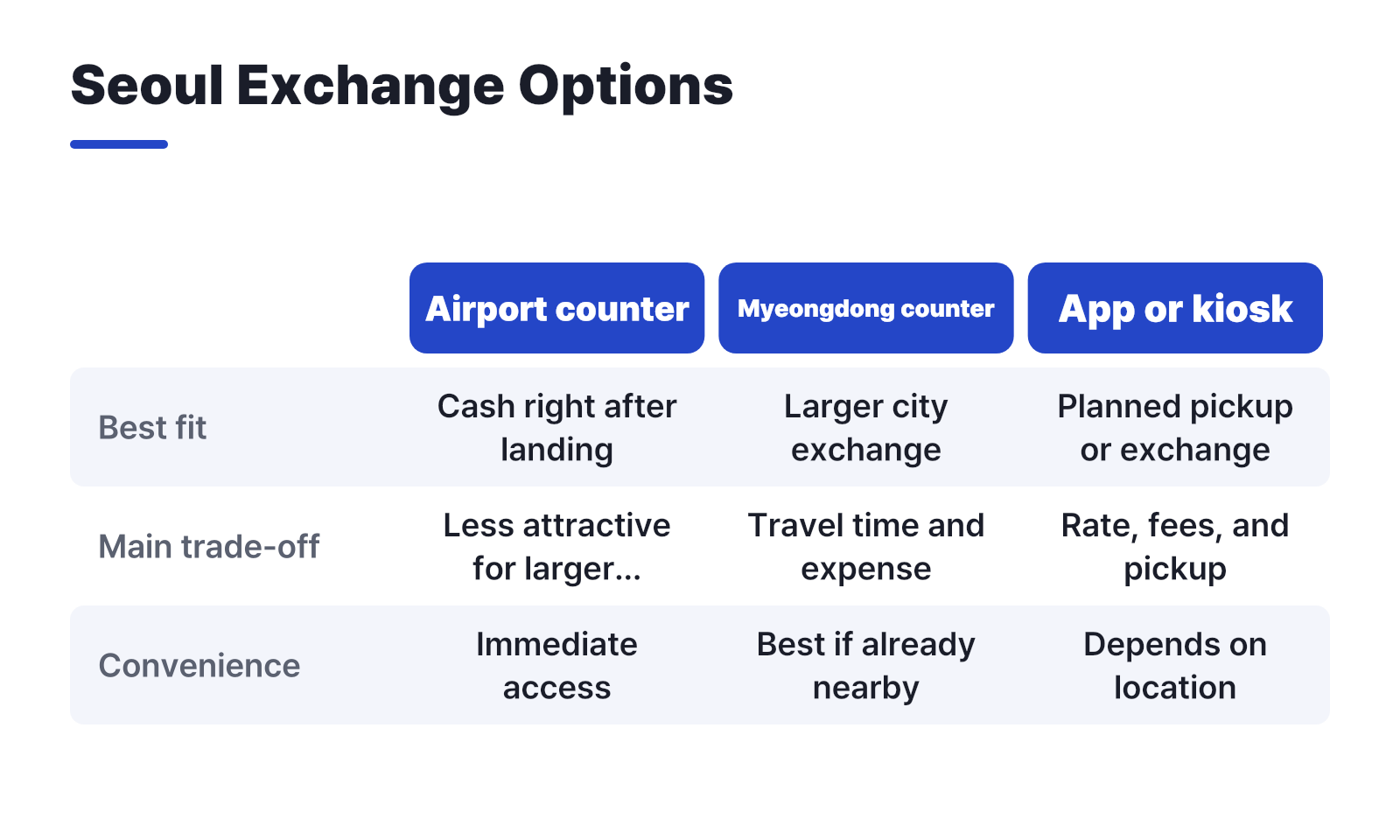
Where to exchange money in Seoul depends on when you need cash and whether you are already going to Myeongdong. Airport counters offer immediate access after landing; Myeongdong is a common choice for exchanging a larger amount in the city; apps and kiosks may suit travelers who want to arrange cash without making a separate visit to a counter.
The exchange rate alone does not tell you what a transaction costs. Compare the final won amount for the same amount of dollars, including any stated fees, and factor in whether reaching the exchange point would add a separate trip to your day.
| Option | Best fit | Trade-off to consider |
|---|---|---|
| Airport counter | A small amount of cash immediately after arrival | Airport exchange is generally less attractive for exchanging a larger amount. |
| Myeongdong counter | A larger exchange when Myeongdong is already on your Seoul plans | Getting there takes time and may add travel expense. |
| App or self-service kiosk | Convenience or an exchange arranged around a planned pickup | The rate, fees, location, and pickup method all affect whether it works for you. |
Is the airport a good place to exchange dollars?
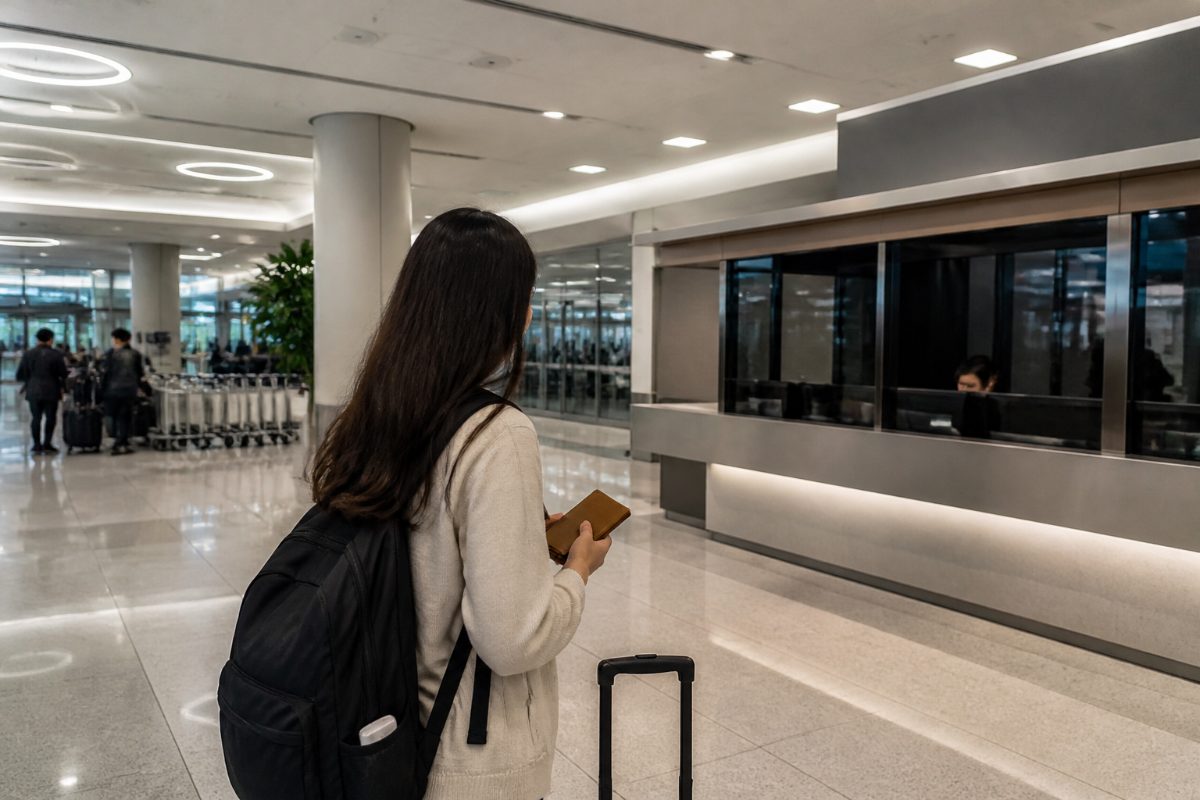
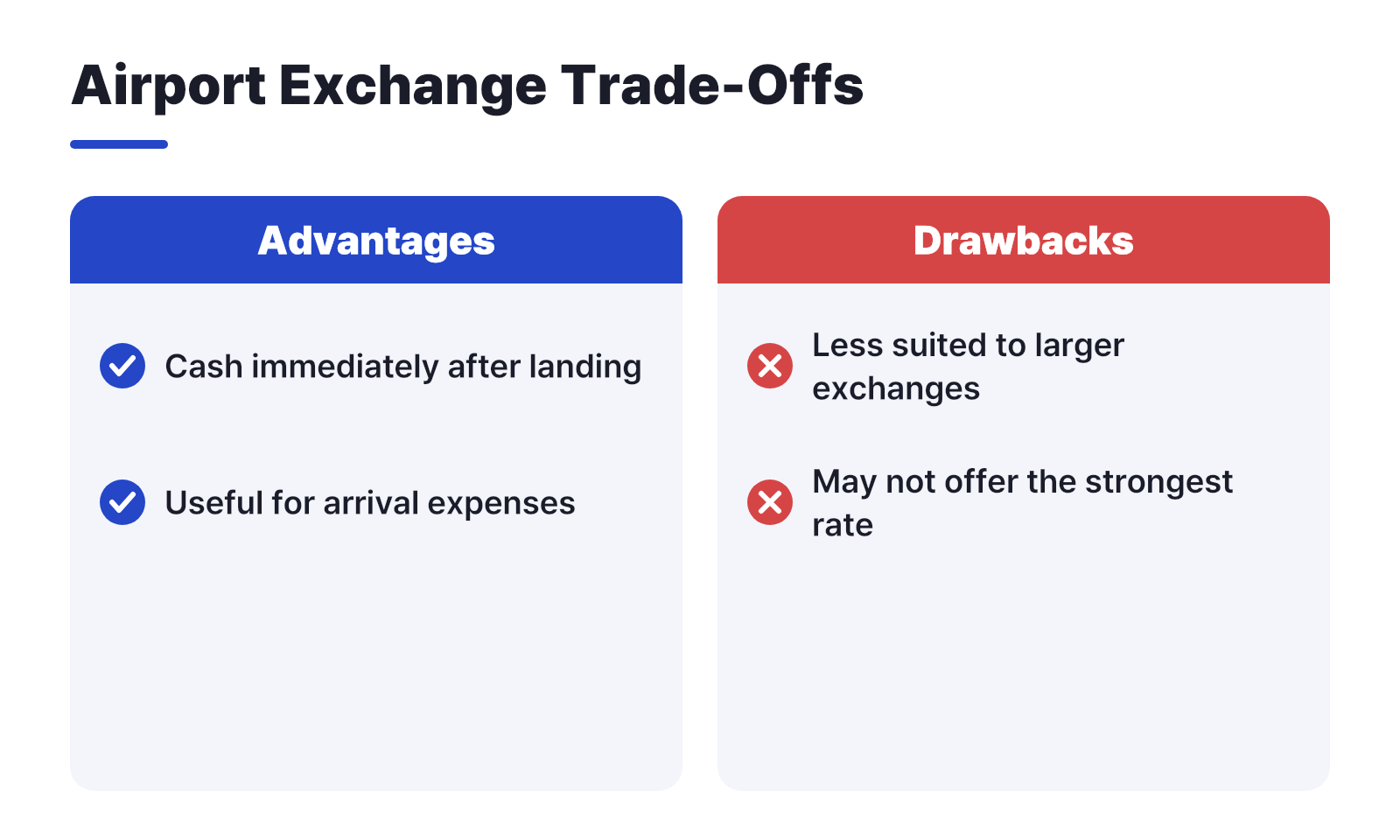
Airport exchange makes sense when having some Korean won immediately is more useful than getting the strongest available rate. A small cash reserve can cover arrival needs such as a meal, transportation, or an urgent purchase while you settle into Seoul.
Airport counters are less suited to changing your entire travel budget at once. A practical approach is to exchange only what you expect to need before reaching the city, then compare city options for the rest. One travel guide gives USD $50–$100 as a rough airport-cash example; treat it as a planning reference rather than a required amount, since your first-day plans determine how much cash is useful.
If you will travel straight from Incheon Airport to a destination outside Seoul, a city exchange stop may not fit your route. An airport exchange or a cash withdrawal can be more practical in that situation, even if a city counter might offer a more favorable rate.
Why choose a Myeongdong exchange counter?
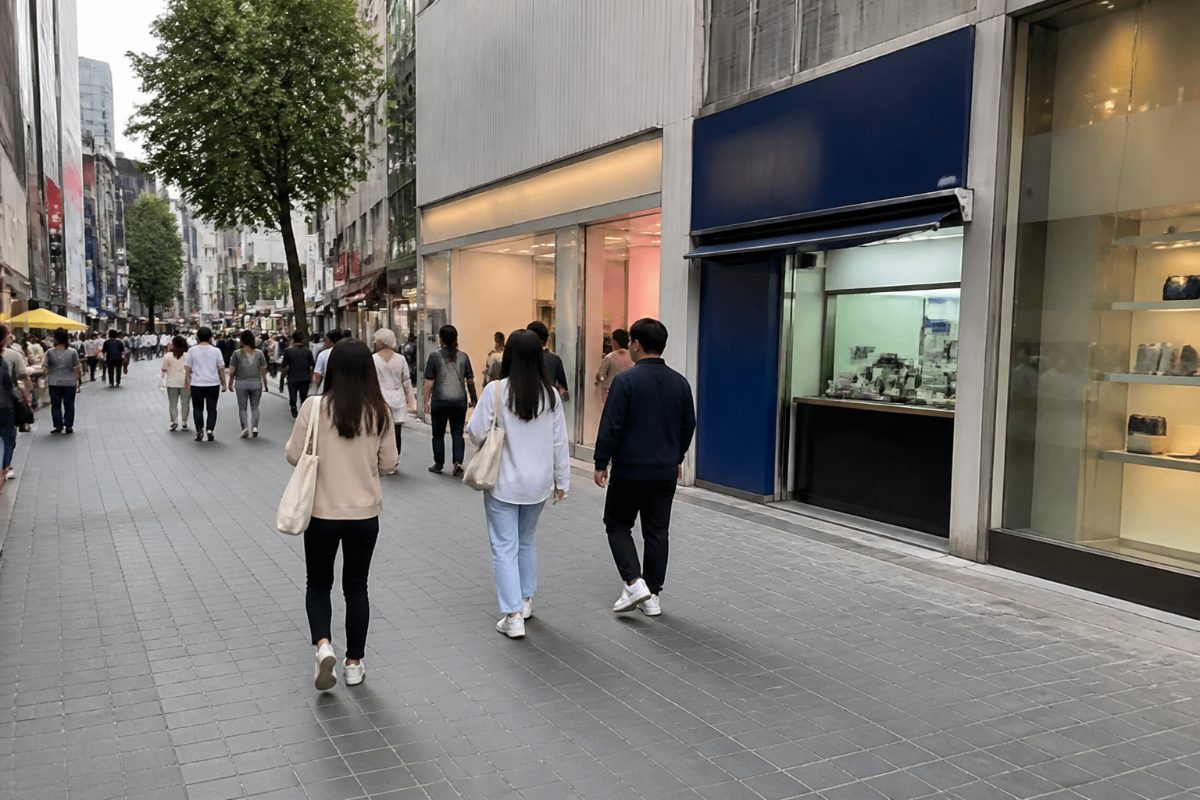
Myeongdong is a popular area for currency exchange, and city exchange counters there are often recommended for larger exchanges. It is most convenient when the neighborhood is already part of your sightseeing or accommodation plans, so you can compare counters without making a separate trip just to change money.
Look at the amount of won you will receive for the same dollar amount at each counter. A better displayed rate may not mean a better final deal if fees apply, and an exchange advantage can be reduced by the time and transport needed to get there. For a small exchange, convenience near your hotel or along your planned route may matter more than a slight rate difference.
Myeongdong is not automatically the right choice for every itinerary. If your Seoul plans do not take you there, weigh the likely exchange benefit against the extra detour. If you are already nearby and changing a larger amount, comparing city counters is a more natural fit.
Can you use an app or a self-service currency kiosk?
Some currency services let travelers arrange an airport exchange in advance, and self-service kiosks offer another way to exchange money. These options can reduce the need to search for a counter after landing, but convenience alone does not establish which option gives the best final amount.
Before choosing an app-based exchange, identify where and how you will receive the cash and whether that location fits your arrival route. Compare the quoted exchange rate and any fees with a counter quote for the same amount. If the pickup point requires a detour, include that inconvenience in your decision rather than treating the app quote as the full cost.
A kiosk can be useful when its location and operating setup match your plans. Its rate and any associated fees still matter, so compare the final won amount just as you would with an airport or city counter. Do not plan around a specific kiosk until you know where the cash is collected and how that fits your schedule.
How should you compare the real exchange cost?
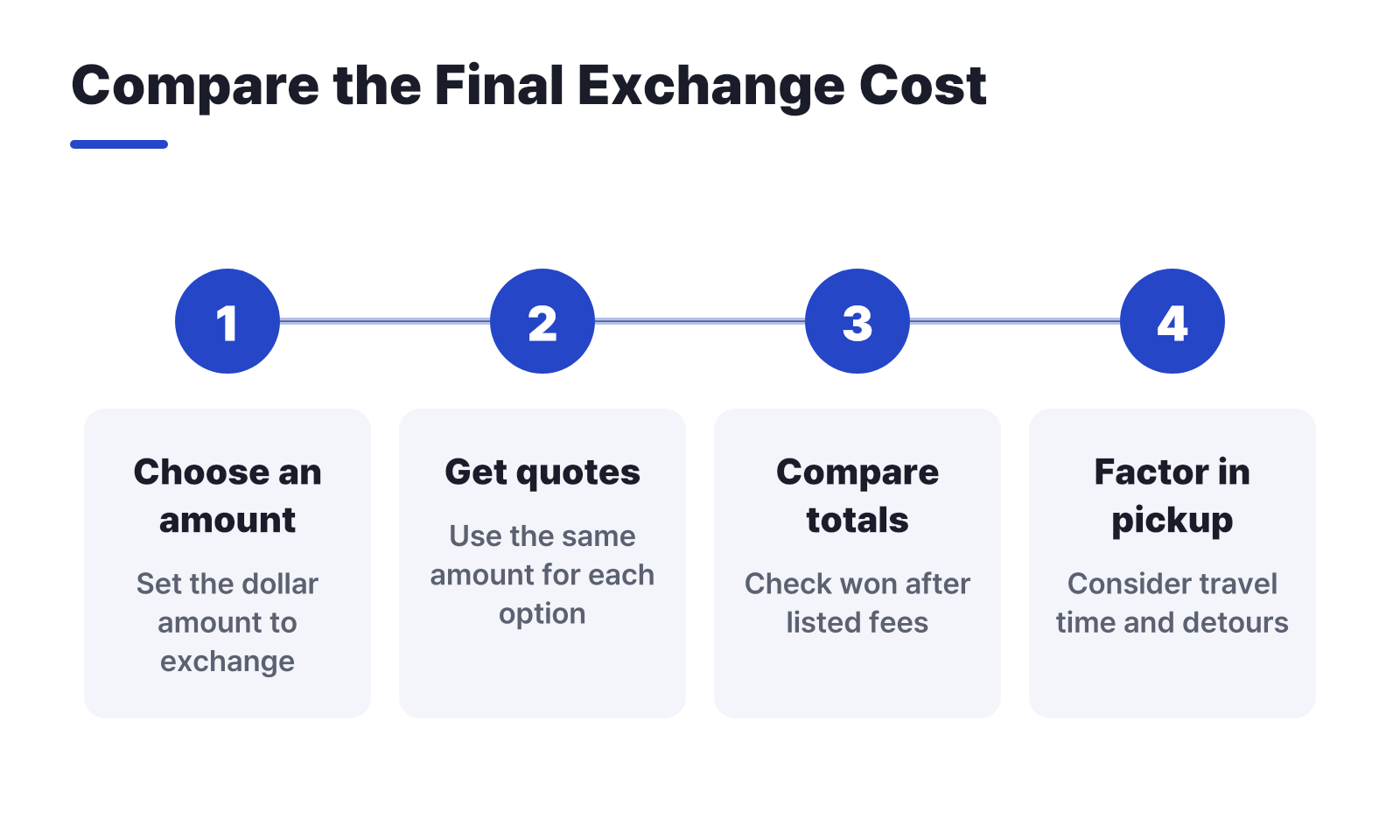
Compare providers using one consistent question: for the same amount of US dollars, how many Korean won will you actually receive after stated fees? This makes the airport, a Myeongdong counter, and an app or kiosk easier to compare without relying on a headline rate that leaves out part of the transaction.
- Choose the dollar amount you are considering exchanging.
- Ask or enter that same amount for each option, using the rate and any listed fee.
- Compare the final won totals, then consider the extra trip or pickup needed to collect the cash.
- Use the most convenient option for a small immediate need; reserve a separate city comparison for a larger exchange if it fits your itinerary.
This comparison also helps you avoid making a long trip for a minor difference. If the city option offers a better quote but reaching it costs time and transport, the practical gain may be small for a modest exchange. For a larger amount, the rate difference has more room to matter, so comparing before you exchange is more useful.
How much cash should you carry in Seoul?
Plan cash around the purchases you expect to make rather than exchanging your full trip budget by default. A travel guide recommends using a credit card for most purchases and keeping cash for needs such as transportation, meals, or emergencies.
One specific cash use to plan for is a T-money transit card: the card can be recharged with cash. If you expect to use one, keep enough won available for a top-up instead of assuming your card will cover every transit-related cash need.
For most Seoul itineraries, start with a small airport exchange if you need immediate cash, use a Myeongdong counter when it fits a larger exchange and your route, and choose an app or kiosk when its rate and pickup arrangement suit your plans. Before you leave home, decide how much cash you need for arrival and compare the final won amount for any larger exchange.
Exchange counters at a glance: hours and locations
The fastest way to decide is to match the counter to your arrival time. At Incheon Airport, Terminal 2 has a KB Bank exchange counter that runs 24 hours, and Woori Bank counters that run 06:00–22:00 (Incheon Airport official facility listings, checked November 16, 2026).
| Place | Where | Hours | Good for |
|---|---|---|---|
| Incheon Airport T2 — KB Bank exchange | Terminal 2, 3rd floor, landside, between exits 4–5 | 24 hours (00:00–24:00) | Late-night and early-morning arrivals |
| Incheon Airport T2 — Woori Bank exchange | Terminal 2, 3rd floor, landside, between exits 8–9 | 06:00–22:00 | Daytime arrivals; also handles online-exchange pickup |
| Myeongdong licensed exchange counters | Myeongdong main streets | Hours vary by shop | Larger amounts; compare the posted rate at each counter |
Cash you will actually need on arrival: a T-money card costs ₩2,500–4,000 at a convenience store, and a top-up is ₩1,000–90,000 per transaction (T-money official site). A typical day of subway and bus rides runs about ₩6,000–9,000 with the transfer discount, so ₩30,000 of loaded credit covers several days.
References
- Best Place to Exchange Money in Korea: Airport vs Myeongdong vs ATM (2026 Guide) - justktravel.com Best Place
- 2026 Where to Exchange Money in Seoul: Myeongdong Currency Exchange Complete Guide - Shh! Just Tell You.
- Korea Currency Exchange Trip: Currency Exchange Tips & Calculator (July 2026)
- 2024 SAC Korea Unofficial Guide - Light Fellowship
- How to Get the Best Exchange Rate in Korea — Airport vs. City vs. App, Fully Compared
Information in this post was checked as of November 2026. Policies and prices may change, so please verify important details with official sources.


Comments
Post a Comment