How to Check Seoul Winter Air Quality by District
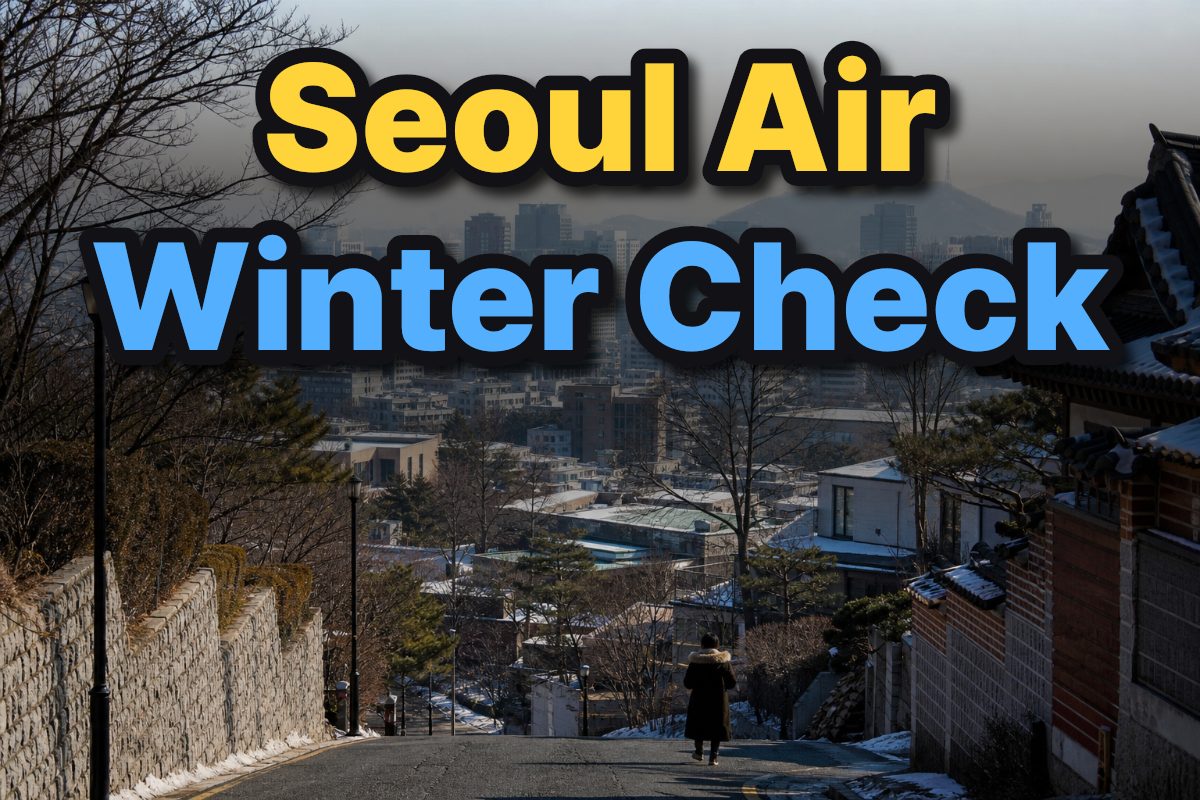
Table of Contents
- Where can you check winter air quality in Seoul?
- How do you read PM2.5 and Seoul’s air-quality categories?
- Why check air quality more often in winter?
- How should you use an air-quality reading to plan a day?
- Which air-quality routine fits your trip?
- Common mistakes when checking Seoul air quality
- Frequently Asked Questions
- A quick Seoul winter air-quality routine
- Key points to remember
To check winter air quality in Seoul, use a local air-quality service and select the district where you plan to spend time. Read the overall category alongside PM2.5, then use that current information—not the season alone—to decide how to arrange outdoor plans.
Where can you check winter air quality in Seoul?
Seoul Metropolitan Government’s air-quality service is a useful starting point for Seoul-specific readings. Its page presents measurements for fine particles, coarse particles, ozone, and comprehensive air quality, and lets you identify a district on the map by moving the pointer over it.
AirKorea and Cleanair.Seoul are also named as places to check air quality in Seoul by Breathesafeair. If you use more than one service, note which one supplied each reading: services can display different index systems, so matching colors do not necessarily mean matching categories.
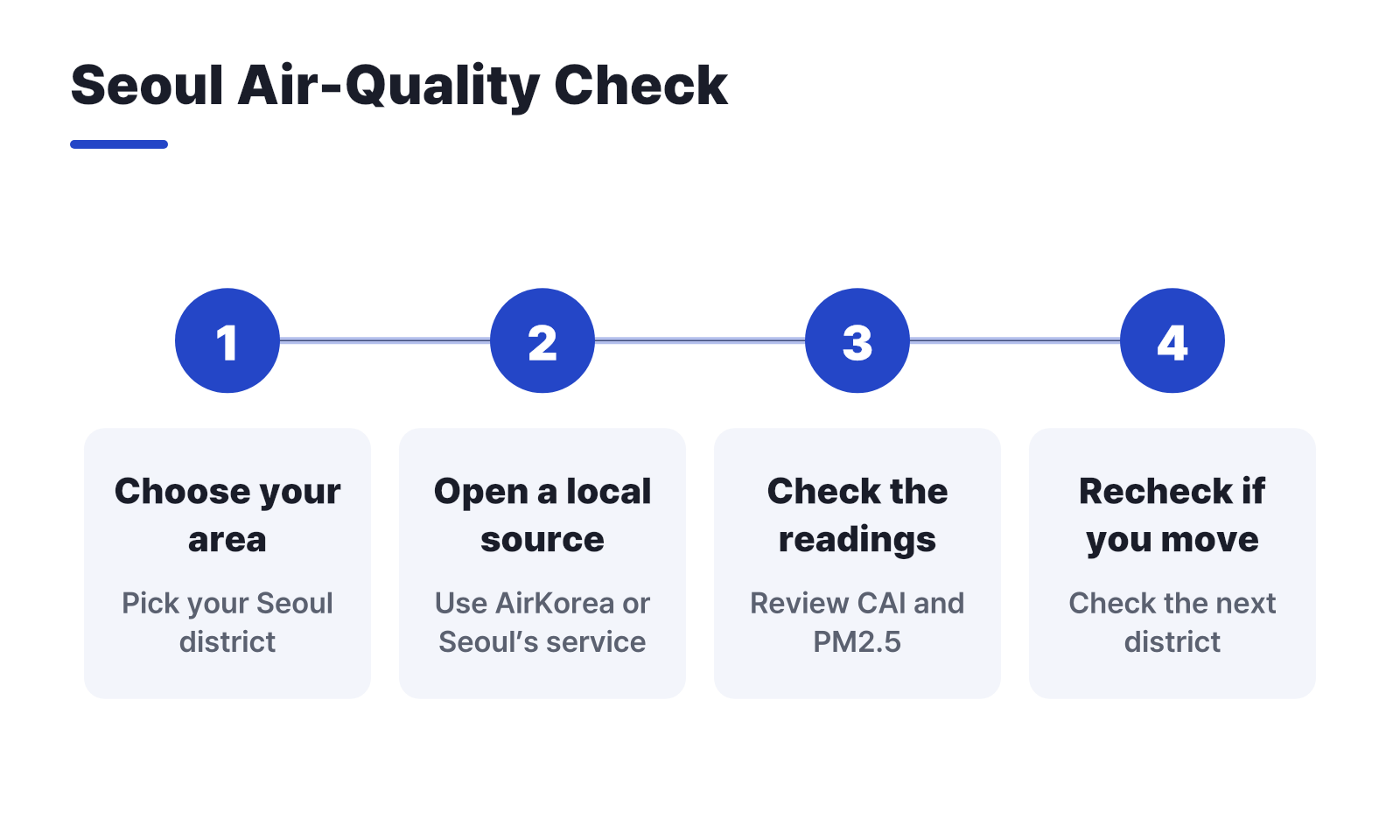
- Choose the area. Start with the district where your next outdoor activity will take place. If you are looking at Seoul’s map, move the pointer over the relevant district to see its name.
- Note the time and area shown. Keep the location attached to the reading rather than treating it as a citywide verdict.
- Read the overall category and pollutant values. The overall category gives a quick summary; PM2.5 and other pollutant measurements add detail.
- Check again if your plans move elsewhere. A reading tied to one district is more useful for that area than for a different part of Seoul.
For a straightforward routine, choose one official local source and use it consistently. A second service can help when you want extra pollutant detail, but it should add context rather than replace the district-specific reading you are using to plan.
Official readings and additional detail
| Resource | Useful for | How to use it |
|---|---|---|
| Seoul Metropolitan Government air-quality page | Seoul-focused pollutant categories and district information | Choose the relevant district and check the pollutant readings as well as comprehensive air quality. |
| AirKorea or Cleanair.Seoul | Another way to check air quality in Seoul | Keep track of the service and index scale shown with the reading. |
| AQICN | Supplementary pollutant detail | Breathesafeair describes it as displaying measurements such as PM2.5, PM10, ozone, and nitrogen dioxide. Treat its index as a separate display, not as an automatic match for Korea’s categories. |
How do you read PM2.5 and Seoul’s air-quality categories?
PM2.5 is particulate matter with a diameter smaller than 2.5 micrometers. The OECD’s report on Korea’s air-quality management defines PM2.5 this way; Seoul Metropolitan Government lists its categories separately from those for coarse particles, ozone, and comprehensive air quality.
The city’s published legend gives the following ranges. These are the category ranges displayed by Seoul Metropolitan Government, not a reason to compare a number directly with a different service’s scale.
| Seoul reading | Good | Moderate | Unhealthy | Very Unhealthy |
|---|---|---|---|---|
| Fine particles (PM2.5) | 0–15 | 16–35 | 36–75 | 76 and above |
| Coarse particles (PM10) | 0–30 | 31–80 | 81–150 | 151 and above |
| Ozone (O3) | 0–0.030 | 0.031–0.090 | 0.091–0.150 | 0.151 and above |
| Comprehensive Air Quality Index | 0–50 | 51–100 | 101–250 | 251 and above |
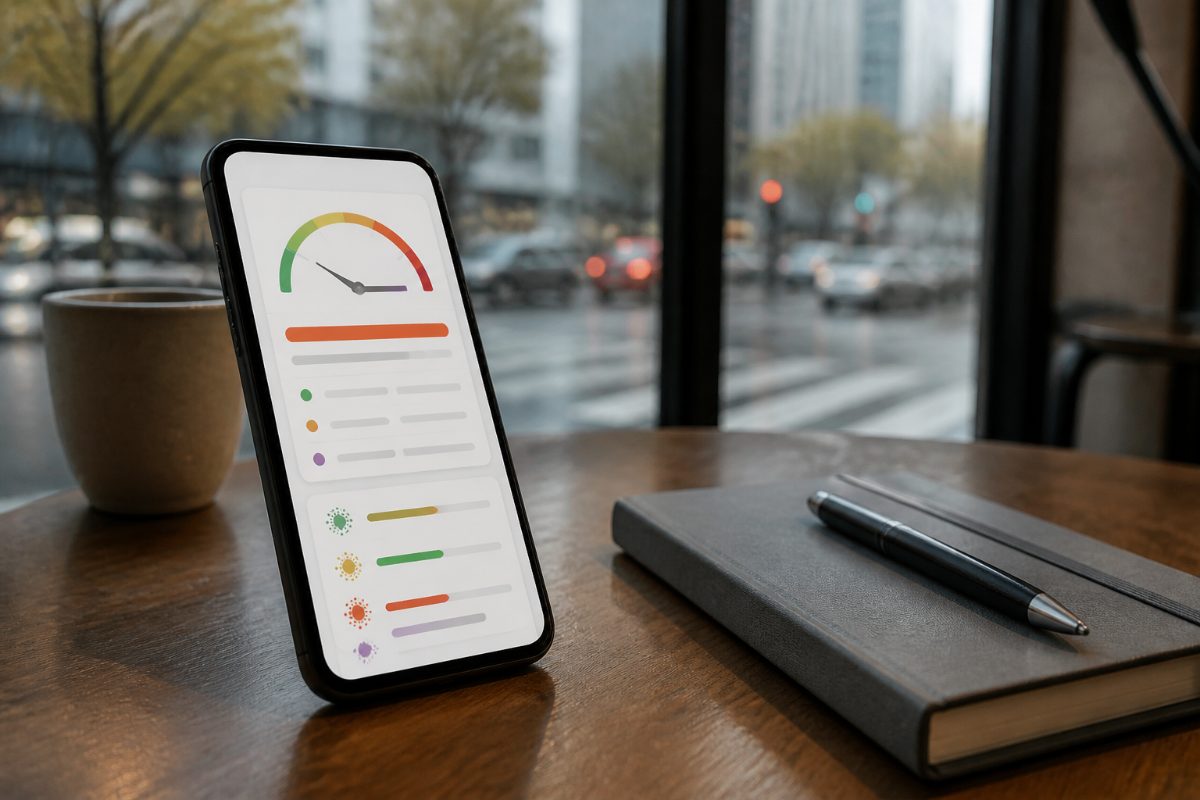
Use the comprehensive category for a quick scan, then look at PM2.5 and any other measurements the service provides. The overall category summarizes conditions in a single label, while the pollutant readings show which specific measure is contributing information to your decision.
Do not assume the same color or number means the same thing across every app. Korea’s Comprehensive Air Quality Index (CAI) and a U.S. AQI display are separate systems. If a third-party service offers a different index, compare its readings with other readings from that same service and keep the scale clearly identified.
Why check air quality more often in winter?
The OECD’s review of Korea’s air-quality management identifies winter and spring as periods when fine-particle pollution has been a particular concern. That seasonal pattern makes a quick check useful during a winter trip, but it does not tell you whether the air will be good or poor on a particular day.
Winter weather can also affect how a day feels outdoors, while air-quality readings provide information about pollution rather than temperature or comfort. Treat these as separate planning questions: check the forecast for clothing and weather, and check a current local air-quality reading for the conditions it reports.
Checking before a long outdoor visit is especially practical because many itineraries have at least some flexibility. You may be able to move an outdoor neighborhood walk to another time, put an indoor stop between outdoor activities, or keep the same plan if the current reading supports it. The reading is most useful when it is recent and tied to the district you intend to visit.
Annual averages and broad seasonal summaries can provide context, but they cannot replace a current local reading. A yearly number describes a longer period; it does not tell you the conditions at a specific place and time. Use seasonal information to remember when to check, rather than to predict the result.
How should you use an air-quality reading to plan a day?
Use the reading as one input when choosing between outdoor and indoor activities. If the local category is less favorable than you expected, consider moving a flexible outdoor stop or switching the order of activities; if you have fixed reservations, preserve those and adjust the parts of the day that can move.
- List the day’s locations. Write down the district for the main outdoor stop and any other area you expect to visit.
- Check the local reading. Open Seoul’s monitoring service or another source that shows the area you need, and note the time attached to the result.
- Compare the summary and details. Read the overall category, then look at PM2.5 and any other pollutant measurements available.
- Choose what can change. Keep fixed bookings in place where possible, and identify a flexible walk, market visit, or other outdoor stop that could move.
- Recheck after changing areas or timing. Use the reading for the next district instead of carrying forward an earlier location’s result.
This approach does not require rebuilding an entire itinerary around each reading. It gives you a simple decision point: keep the plan, change its order, or choose an indoor alternative for the part of the day that is easiest to move.
Air-quality categories are general information, not personal medical guidance. Travelers with a health condition affected by air pollution can use advice from their healthcare professional when deciding what level of outdoor activity is appropriate for them.
Which air-quality routine fits your trip?
The best routine depends on how much of your day is outdoors and how familiar you are with air-quality apps. A first-time visitor can keep the process simple with one local source; someone planning a full day outdoors may prefer to check the district and pollutant details more closely.
| Traveler situation | Practical routine | Why this fits |
|---|---|---|
| First visit to Seoul | Check one local service before the day’s main outdoor activity. | A single source is easier to interpret and reduces confusion between different index scales. |
| Outdoor-focused itinerary | Check the district, comprehensive category, and PM2.5; review other pollutants shown. | Location and pollutant detail provide more context than a general impression of Seoul. |
| Plans across several districts | Recheck when moving to another area rather than relying on the first reading. | The Seoul map identifies districts, so you can connect a reading to the place you plan to visit. |
| Already uses an air-quality app | Use it for additional detail, while keeping its index scale separate from Korea’s CAI. | Different scales can label readings differently even when they display similar colors. |
| Fixed indoor bookings and flexible outdoor stops | Keep the fixed reservation and shift the outdoor activity if the reading leads you to adjust. | Changing the order preserves the parts of the day that cannot easily move. |
For many visitors, checking once before the main outdoor activity is enough to make a plan. A second check is most useful when the itinerary changes location, the activity is prolonged, or you want to compare the conditions at a different time.
Common mistakes when checking Seoul air quality
- Using a seasonal pattern as today’s forecast. The OECD describes winter and spring as periods of particular fine-particle concern, but a seasonal description does not give the current reading for your destination.
- Comparing colors from different services. Seoul Metropolitan Government lists separate categories for each pollutant and its comprehensive index. A third-party display may use a different index, so identify the scale before comparing.
- Looking only at the overall category. The comprehensive index is useful for a quick summary, but PM2.5 and other available measurements provide pollutant-specific detail.
- Checking only one district for a multi-area day. Seoul’s service lets users identify districts on its map. Check the area relevant to the next activity rather than assuming one reading describes every stop equally well.
- Treating an annual average as a live update. Long-term averages describe a longer period. For today’s outdoor plans, use a current reading tied to the place you will visit.
If the reading leads you to switch to an indoor plan, our list of indoor things to do in Seoul can help you choose a different kind of day out, and a jjimjilbang visit offers an option when you want to spend more time inside.
Frequently Asked Questions
Where can I check air quality for a specific Seoul district?
Seoul Metropolitan Government’s air-quality page shows pollutant categories and a district map. Move the pointer over a district to identify it, then use the reading for the area where you plan to spend time.
What is the difference between PM2.5 and PM10?
PM2.5 refers to particulate matter smaller than 2.5 micrometers in diameter, while Seoul lists coarse particles (PM10) as a separate measurement. Check both readings if the service provides them, rather than treating one as a substitute for the other.
Is Korea’s CAI the same as the U.S. AQI?
No. Korea’s Comprehensive Air Quality Index and a U.S. AQI display are different index systems. Keep the source and scale attached to each reading, and compare like with like instead of interpreting the colors as interchangeable.
Does Seoul always have poor air in winter?
No. Winter and spring have been identified as periods of greater fine-particle concern in Korea, but that seasonal pattern does not describe the air on every day. Check a current reading for the district you plan to visit.
How often should I check during a day in Seoul?
Check before the main outdoor activity, then check again if your plans move to another district or you want to make a later decision based on current conditions. For a mostly indoor day, the location-specific reading is most relevant when you add an outdoor stop.
A quick Seoul winter air-quality routine
Before heading outdoors, open a local air-quality service, choose the district you plan to visit, and note the overall category and PM2.5. Review any other pollutant readings available, keep different index scales separate, and check again if your plans move to another part of Seoul. This routine uses current, location-specific information without treating a seasonal pattern or annual average as a prediction for today.
Seoul Metropolitan Government’s published category ranges and district map are available on its air-quality page; check that page when you need to confirm the current display or its category labels.
Key points to remember
- Choose a reading for the district you are actually visiting.
- Use the overall category for a quick view and PM2.5 for pollutant-specific context.
- Keep Korea’s CAI separate from other services’ index scales.
- Use seasonal patterns as a reminder to check, not as a substitute for current conditions.
References
- Air Quality - Seoul Metropolitan Government
- Air Pollution in Seoul: Navigating Health Risks in the Urban Haze
- Policies, regulatory framework and enforcement for air ...
- edf90b7a-2024_world_air_quality_report_vf.pdf
Information in this post was checked as of November 2026. Policies and prices may change, so please verify important details with official sources.


Comments
Post a Comment